

KORE Aviation - Learning to fly is one of the most rewarding challenges you will ever take on. It is also one of the most expensive. With the total cost of a Private Pilot License (PPL) currently ranging between $15,000 and $23,000, every dollar you spend matters. Many new aviators fall into the trap of buying gear that looks cool in a catalog but does very little to help them pass a checkride. These student pilot mistakes buying equipment can easily add $2,000 or more to your training costs without providing any real benefit to your skills.
The reality of flight training is that the real investment is flight hours. Every $200 you waste on a fancy gadget is one less hour of instruction in the cockpit. To help you keep your budget on track, I have put together a list of the five most common things student pilots waste money on and what you should buy instead to maximize your training budget.
Also read: First Flight Lesson: What to Expect

1. Premium ANR Headsets During Initial Training
The biggest student pilot mistakes buying gear usually happens right at the start with the headset. You will see experienced airline pilots or wealthy aircraft owners wearing Active Noise Reduction (ANR) headsets that cost between $800 and $1,300. While these are great pieces of technology, they are a massive waste of money for a student pilot.
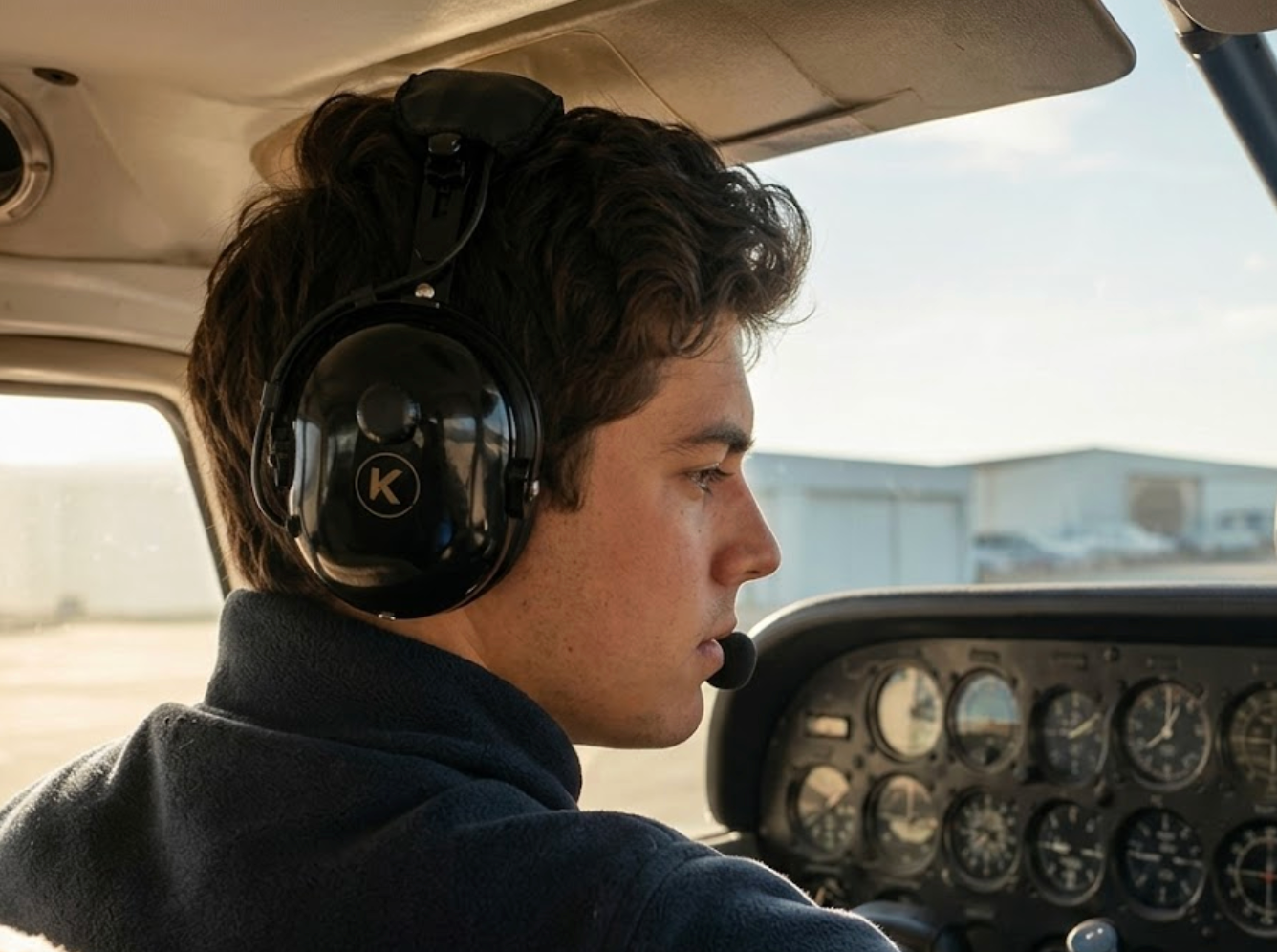
Passive Noise Reduction (PNR) headsets provide more than enough protection for the typical training environment. A high quality PNR headset like the KORE Aviation KA-1 costs $224.95 and offers 24 dB of noise reduction. This is the exact same level of hearing protection you get from many premium brands, just achieved through physical seals rather than electronic cancellation. By choosing a KA-1 over a $1,100 premium model, you save nearly $900. That is enough money to pay for five or six hours of wet rental time in a Cessna 172.
Furthermore, PNR headsets are often better for students because they allow you to hear the engine and the airframe more clearly. Learning to "listen" to the airplane is a vital skill. You want to hear the change in engine RPM or the whistle of the wind as you approach a stall. Premium ANR can sometimes mask these subtle cues. Save the $1,000 investment for when you have your license and are flying long cross-country trips.
Read more: PNR vs ANR Headsets: Which Suits Best for Student Pilots
2. Too Many Physical Books and Study Materials
It is tempting to buy every "Complete Pilot Kit" you see online. These kits often cost between $200 and $400 and come with a dozen thick textbooks. The truth is that the FAA provides almost all of your primary study material for free. The Pilot's Handbook of Aeronautical Knowledge (PHAK) and the Airplane Flying Handbook are available as free PDFs on the FAA website. They are the gold standard for what you need to know for your checkride.
Instead of buying a mountain of paper that will be outdated in two years, invest in one good digital test prep app. Most reputable apps cost between $100 and $150. These apps provide practice questions, video lessons, and digital versions of the necessary charts. This approach keeps your flight bag light and your bank account full. You do not need a $50 hardback book on weather when the same information is available for free from the source.
| Item | The "Wasteful" Way | The Smart Way | Savings |
|---|---|---|---|
| Headset | Premium ANR ($1,100) | KORE KA-1 PNR ($224.95) | $875.05 |
| Study Materials | Physical Book Bundle ($350) | Free FAA PDFs + One App ($120) | $230.00 |
| Flight Bag | Designer Pilot Bag ($250) | Sturdy Backpack or KORE Bag ($60) | $190.00 |
| Total | $1,700 | $404.95 | $1,295.05 |

3. Expensive Designer Flight Bags
You will see flight bags marketed for $200 or even $300 that claim to have specialized pockets for everything from your fuel tester to your sunglasses. While organization is important, a specialized bag does not make you a better pilot. During your first 20 hours of training, you really only need to carry a headset, a logbook, a tablet, and a small kneeboard.
A simple, sturdy backpack you already own is often the best choice. If you really want a dedicated bag, KORE Aviation offers affordable pilot bag options that provide the necessary padding for your headset without the "aviation markup" found at boutique shops. Spending $250 on a bag before you even know what gear you prefer to carry is one of the classic student pilot mistakes buying equipment early on. Use that money for a cross-country flight lesson instead.
4. Unnecessary Cockpit Gadgets
The modern cockpit is full of technology, and it is easy to get "shiny object syndrome." Many students rush out to buy portable ADS-B receivers, fancy EFB (Electronic Flight Bag) mounts, or backup digital instruments. These items can easily total $1,000 or more.
During your PPL training, your primary focus should be looking out the window. Your training aircraft is already equipped with the instruments required for your certificate. Adding more screens and gadgets only creates distractions. The only tech investment worth making early is a reliable tablet with a subscription to a flight planning app like ForeFlight. This will cost you about $100 per year. Wait until you are a certificated pilot before you start building a portable avionics suite. You need to learn how to fly the airplane first, not how to manage a dozen different apps and devices.
5. Renting Headsets Instead of Buying
This is the "sneaky" waste of money. Many flight schools rent headsets for $5 to $15 per flight. It seems like a small amount, but it adds up incredibly fast. If you take 60 hours to get your license, and each lesson is 1.5 hours, you are looking at 40 flights. At $10 per rental, you have spent $400 on a headset you don't even own. Even worse, rental headsets are often worn out, have degraded ear seals, and have been worn by hundreds of other people.
Buying a KORE Aviation P1 for $124.95 or a KA-1 for $224.95 is a much smarter financial move. A $225 headset pays for itself in about 23 flights if the rental rate is $10. Not only do you save money in the long run, but you also have a clean, reliable piece of equipment that you know how to operate. You won't have to spend the first five minutes of every lesson fighting with a loose microphone or a scratchy volume knob on a beat up rental unit.
Also read: How Much Should You Spend on Your First Aviation Headset?
The "Buy This, Not That" Comparison
To keep your student pilot budget tips simple, follow this guide for your initial gear purchase. Focus on durability and value rather than brand prestige.
- Buy This: A reliable PNR headset like the KORE KA-1 ($224.95). It includes gel ear seals and a 5-year warranty.
- Not That: A $1,200 ANR headset that requires batteries and costs as much as 8 hours of flight time.
- Buy This: A basic aluminum kneeboard ($20) to hold your notepad and iPad.
- Not That: A $150 "tactical" kneeboard with built-in lights and cooling fans.
- Buy This: A digital subscription to a test prep course ($100).
- Not That: A $400 physical "ground school in a box" that you will never finish reading.
By making these choices, you can easily save $1,500 or more. In the world of flight training, $1,500 is a massive safety margin for your budget. It covers the cost of extra flight hours if you struggle with landings or the fees for your written exam and checkride.
Read more: How to Choose the Right Aviation Headset (And Not Overpay)

Frequently Asked Questions
1. Is a PNR headset quiet enough for a noisy Cessna or Piper?
Yes. A quality PNR headset like the KA-1 provides 24 dB of passive noise reduction. This is the industry standard for hearing protection. As long as the ear seals make a good fit against your head, you will be well protected from engine noise.
2. Should I wait until I pass my solo to buy a headset?
No. You should buy a headset before your second or third lesson. Renting is a "sunk cost" that provides no return. Owning your own headset ensures consistency in what you hear and how you communicate with ATC.
3. Do I need a backup headset as a student?
Generally, no. Your flight instructor will have their own headset, and most flight schools have a spare if yours fails. Save the money for a backup headset for when you start carrying passengers after you get your license.
4. Why do some headsets cost $1,000 if the protection is the same?
Premium headsets use electronics to cancel out low frequency noise, which can be more comfortable on 4-hour flights. They also often include Bluetooth for music or phone calls. These are luxuries, not necessities for a student learning to fly in the local pattern.
5. Can I use my KORE headset after I get my license?
Absolutely. Over 30,000 pilots trust KORE Aviation. Many pilots use their KA-1 for their entire flying career, while others eventually move it to the passenger seat if they decide to upgrade to ANR years down the road.
Bottom Line
Flight training is expensive enough without wasting money on gear you do not need. By focusing on practical equipment like a reliable KORE Aviation headset, free FAA study resources, and essential flight gear, you can save well over $1,000 and put that money where it matters most: more flight hours, better training, and becoming a safer pilot. Explore the full lineup of KORE Aviation headsets and pilot gear to build your flight bag with confidence from day one.


