

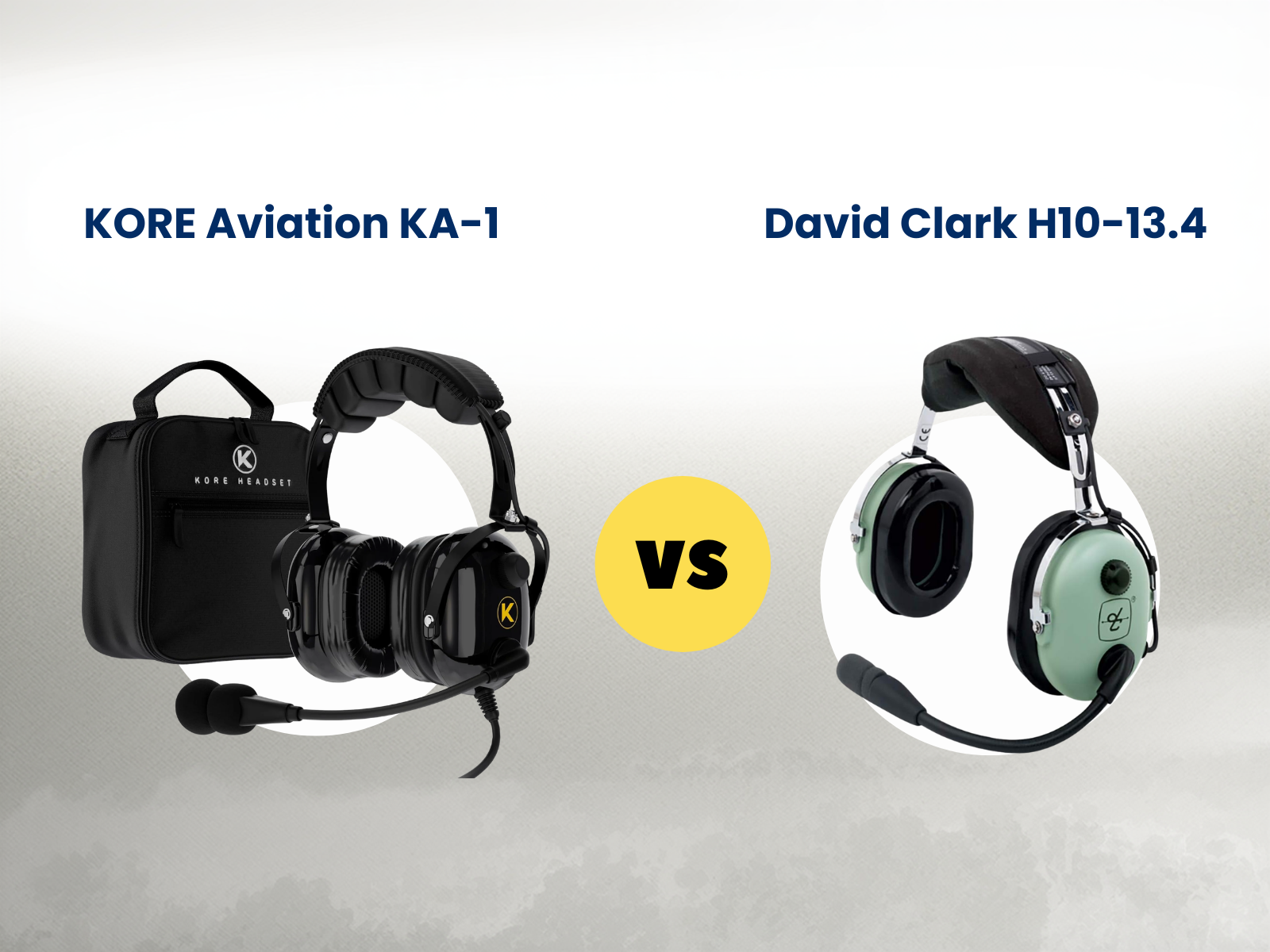
KORE Aviation - If you are shopping for your first real aviation headset, there is a good chance you have looked at the David Clark H10 13.4 and wondered if it is worth the price. It has been around a long time, and a lot of pilots know the name. At the same time, many student pilots are trying to make smart choices with their training budget, which is where the KORE Aviation KA-1 starts to look interesting.
On paper, the two headsets are closer than many people expect. They are both passive headsets, both built for fixed wing flying, and both aimed at pilots who want durability and clear audio. The biggest difference is that the KORE Aviation KA-1 includes a few features that student pilots may appreciate right away, while still staying in a much more budget friendly range.
That does not mean these headsets are identical. They are not. The David Clark has the long standing reputation and the familiar name. The KORE Aviation KA-1 feels more like a value focused option for pilots who care about what they are actually getting for the money.
For a student pilot, that makes this a very fair comparison.
KORE Aviation KA-1 vs David Clark H10-13.4: Spec Comparison
Here is a simple side by side look at the main differences.
| Feature | KORE Aviation KA-1 | David Clark H10-13.4 |
|---|---|---|
| Price | $224.95 | ~$400–450 |
| Noise Reduction (NRR) | 24 dB | 23 dB |
| Ear Seals | Silicone gel (standard) | Foam (gel upgrade ~$50 extra) |
| Microphone | Noise-canceling electret with preamp, 360° flex boom | Noise-canceling electret, flex boom |
| Audio Mode | Mono & stereo | Mono only |
| AUX Input (3.5mm) | Yes | No |
| Volume Control | Individual per ear | Single |
| Headband | Steel-reinforced | Steel with suspension |
| Carrying Case | Included | Not included |
| Warranty | 5 years | 5 years |
| Student pilot value | Stronger feature set for the money | Higher price for a more traditional setup |
That table alone tells most of the story. The KORE Aviation KA-1 is not trying to beat the David Clark on brand history. It is trying to give student pilots a practical set of features at a lower price point.
Why This Comparison Matters for Student Pilots
A lot of student pilots do not buy one headset for one month. They buy one headset hoping it will carry them through private pilot training, checkride prep, cross country work, and maybe even the next rating after that.
That makes this decision bigger than it first looks.
If you buy too cheap, you may end up replacing the headset sooner than expected. If you spend too much too early, you may wish you had used that money for more flight time.
That is why this comparison matters. It is not really about chasing the “best” headset in a vacuum. It is about choosing the one that makes the most sense for where you are right now in training.
Ear Seals: Gel Standard vs. Foam Standard
For most student pilots, comfort becomes a bigger deal after the first few lessons.
At the start, almost any headset feels fine because everything is new and exciting. But after more time in the airplane, small things stand out. If the seal presses too hard, if the ear cups get hot, or if the fit starts to feel tiring after an hour, you will notice it every single lesson.
This is one area where the difference between these two headsets is easy to understand.
The David Clark H10 13.4 comes with foam ear seals as standard. Foam works, and plenty of pilots have used it for years. But foam does flatten over time, and once that happens the fit can feel less comfortable and the seal may not stay as consistent.
The KORE KA-1 comes with silicone gel ear seals standard. For many pilots, gel seals feel softer and spread pressure more evenly. That can make a real difference if you are flying often or wearing the headset for longer lessons.
This does not mean every pilot will prefer one fit over the other. Comfort is personal. But for a student pilot comparing what comes in the box, the KORE Aviation setup is easier to like right away.
Price: Where the Math Gets Interesting
The H10-13.4 runs $400–450 depending on the retailer. Add gel ear seals ($50) and a carrying case ($30–40), and you're looking at $480–540 to match what the KA-1 offers at $224.95.
That's not a small difference. It's the cost of a discovery flight, a few hours of instruction, or a solid chunk of your training budget. For a student pilot watching every dollar, that gap matters.
And this isn't a case of cutting corners to hit a lower price. The KA-1 specs at 24 dB NRR one decibel higher than the H10-13.4. It includes a noise-canceling electret mic, steel-reinforced headband, 5-year warranty, and a carrying case. The savings come from KORE Aviation selling direct, not from cheaper materials.
Features the KA-1 Has That the H10-13.4 Doesn't
Beyond matching the David Clark on core specs, the KA-1 includes a few extras that the H10-13.4 simply doesn't offer:
- Stereo capability: The H10-13.4 is mono only. The KA-1 supports both mono and stereo, useful if you're listening to music or audio courses between legs.
- AUX input (3.5mm): Plug in your phone or tablet directly. The David Clark doesn't have one.
- Individual volume control per ear: Adjust each side independently. The H10-13.4 has a single volume knob.
None of these are deal-breakers on their own. But stacked together, they add up to a more versatile headset, at a lower price.
Also read: Which Aviation Headset Is Right for Beginner Student Pilots?
When the David Clark H10-13.4 Makes Sense
To be fair, the David Clark still has some real strengths.
- It has a long history: David Clark has been making aviation headsets since the 1970s. Your CFI probably trained in one. There's a reason "David Clark" is almost synonymous with "aviation headset."
- Parts are easy to find: Because the brand has been around so long, replacement parts and accessories are widely available.
David Clark earned its reputation over decades. Nobody should knock that. The question is whether you're paying for performance, or for the name on the ear cup.
When the KORE Aviation KA-1 Makes Sense
If you compare the specs and decide based on what you're actually getting for your money, the KA-1 is hard to beat.
- Student pilots: You need a headset that will last through training without draining your budget. The KA-1 covers private through commercial with a 5-year warranty.
- Pilots upgrading from budget headsets: If you started with a $100 headset and want something that feels like a real investment, the KA-1 is the jump that makes sense, without jumping to $400+.
- Pilots who want gel seals without paying extra: Every dollar you add on top of the H10-13.4's price tag to match KA-1 features widens the gap.
- Anyone who looks at the specs and asks, "Why would I pay double?"
The Bottom Line
The David Clark H10-13.4 is a great headset. It's been the standard for a reason, and nobody's arguing otherwise.
But specs don't lie. The KORE Aviation KA-1 matches the H10-13.4 on noise reduction, mic quality, build materials, and warranty, and includes gel ear seals, a carrying case, stereo capability, and an AUX input that the David Clark doesn't. All for roughly half the price.
David Clark set the standard. The KORE Aviation KA-1 meets it, and lets you keep $200 in your pocket for flight time.
Frequently Asked Questions
-
Is the KORE Aviation KA-1 as good as a David Clark?
Spec-for-spec, yes. The KA-1 matches the David Clark H10-13.4 on noise reduction (24 dB vs. 23 dB), microphone type, headband construction, and warranty length. It includes gel ear seals and a carrying case standard, both are extras with the David Clark. The main difference is brand history, not performance. -
Why is the David Clark H10-13.4 so much more expensive?
Brand premium and distribution costs. David Clark has been in aviation since the 1970s and sells through a wide network of retailers and distributors. KORE sells direct to pilots, which cuts out middlemen and keeps prices lower without sacrificing build quality or materials. -
What's the noise reduction difference between the KA-1 and H10-13.4?
The KA-1 is rated at 24 dB NRR. The H10-13.4 is rated at 23 dB NRR. Both are passive noise reduction (PNR). In practice, the difference is minimal, but the KA-1's gel ear seals maintain a better seal over time, which can make a real-world difference in sustained noise reduction. -
Does the KA-1 work with Garmin and Foreflight audio?
Yes. The KA-1 has a 3.5mm AUX input, so you can plug in your phone or tablet directly for music, ATC audio, or app-based flight instruction. The David Clark H10-13.4 does not have an AUX input. -
Can I use the KA-1 in a helicopter?
The KA-1 uses dual GA plugs, it's built for fixed-wing aircraft. For helicopter use, check out the KORE Aviation H1, which uses a U-174 plug designed for rotorcraft. -
How long will the KORE Aviation KA-1 last compared to a David Clark?
Both headsets are built to last thousands of flight hours, and both come with 5-year warranties. The KA-1 uses a steel-reinforced headband and silicone gel ear seals that hold up over time. Replacement parts are available directly from KORE's U.S.-based support team. -
Are gel ear seals really worth it?
A lot of pilots think so. Comfort becomes more important the more often you fly, and gel seals often feel better over longer lessons. -
Does the KORE Aviation KA-1 have enough noise reduction for training?
Yes, for many student pilots it should. Its passive noise reduction rating is in the range that works well for common training aircraft.
-
Can I use the KORE Aviation KA-1 after training?
Yes. A headset like this can easily stay useful after your private pilot training for local flights, rentals, passenger use, or as a dependable backup.
For student pilots who want something more comfortable and better equipped than a very basic starter headset, the KORE Aviation KA-1 is an easy one to consider. It covers the features many students care about most without pushing into premium pricing.
Check out here:


